How long does full arch implant treatment take now?
Alex describes going from failing teeth to fixed final teeth in as few as 3 appointments: surgery, data collection, then fitting the final bridge. He contrasts that with a decade ago, when it meant dentures for 6 months, then implants, then 4 to 6 months of healing before the teeth were started.
Request a consultationA decade ago this treatment took the best part of a year, and most people asking about it are still picturing that version.
What it used to be
Teeth extracted. Dentures for 6 months while the gum healed. Then implants placed. Then 4 to 6 months of healing on top of that. Only then did the phase of actually making the teeth begin, with physical impressions and multiple separate stages.
Alex's word for it is incredible, in the literal sense. That was the standard of care, and it was a year of your life with a denture in the middle of it.
What he describes now
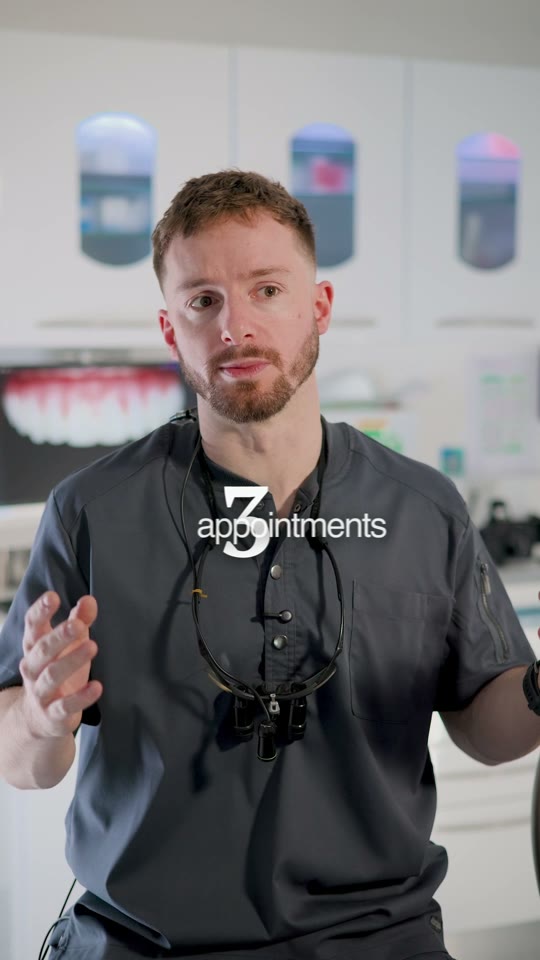
Three appointments. Surgery, data collection, fit the final bridge work.
From no teeth, or teeth that are failing, to fixed final teeth. In his words, it is not a really long drawn out process necessarily any more.
Why it compressed
Planning, and specifically digital planning. Modern implants can be planned to within 1 millimetre of the final position, so they can be placed almost exactly where they were intended to go rather than approximately there.
The consequence of that precision is the interesting bit. Sometimes it is accurate enough that the bridge can be prefabricated before the surgery and simply screwed in afterwards. The teeth exist before the implants do.
Alex's summary: modern implant dentistry is planned digitally, it is quicker, more predictable and safer than it ever has been.
The judgement that comes before any of it
None of which answers whether you should have it, and he does not let that slide. Sometimes some teeth can be saved. Other times a full arch approach is genuinely needed.
He describes feeling an obligation to plan patients comprehensively so that they end up with a reliable set of teeth. That is a different starting point from deciding on the treatment and then finding the patient for it, and the case against clearing everything out is the other half of it.
Read it in Alex's own words
I had a patient who came in with no teeth at the front. When she got 3 implants in the upper jaw and she's got no front teeth, I feel a bit of an obligation to plan patients comprehensively so that we're giving someone a reliable set of teeth.
Sometimes some teeth can be saved, and other times we really need a full arch approach, where all of the teeth come out and the implants go in and the teeth go in on the day. We can take patients from no teeth, or teeth that are failing, to fixed final teeth in as few as 3 appointments. Surgery, data collection, fit the final bridge work. So it's not a really long drawn out process necessarily any more.
So with the implant, I mean, modern implants can be planned to within 1 millimetre of the final position. So we know that we can place them super accurately in the bone, in almost exactly the position that we want. Sometimes so accurately that we can prefabricate the bridge and then just screw the bridge in. So it's pretty cool. Modern implant dentistry is planned digitally. It's quicker, it's more predictable and it's safer than it ever has been.
It's incredible that a decade ago, a patient who was having teeth extracted because they're failing had to have dentures for 6 months, then implants, let the implants heal for 4 to 6 months, and then start the phase of making the teeth with physical impressions, with gooey stuff in the mouth and multiple different stages. And now we can do it in 3 appointments.