Are direct-to-consumer aligners safe, or should a dentist do it?
Moving teeth is treatment, so somebody has to be accountable for it. Alex's position is that clear aligner treatment should be monitored by a dentist who knows what the risks are, rather than ordered direct. In this case the teeth were straightened and the smile widened over roughly 46 weeks.
Request a consultationShe was a singer, she was embarrassed about the crowding, and she had already decided what she was going to do about it. She was going to order aligners from a direct-to-consumer brand.
Alex's counter-offer was not "those are dangerous". It was come and see me and do clear aligner treatment monitored by a dentist.
The argument, which is about accountability rather than plastic
His reasoning has three parts and none of them are about the aligners themselves:
- It is safer moving teeth when someone is responsible for it.
- Someone is accountable.
- We know what the risks are if you are having orthodontic treatment done.
Then the conclusion: it should really be done by a dentist. That is a positional claim and he states it as one rather than dressing it up as a warning.
What was actually wrong
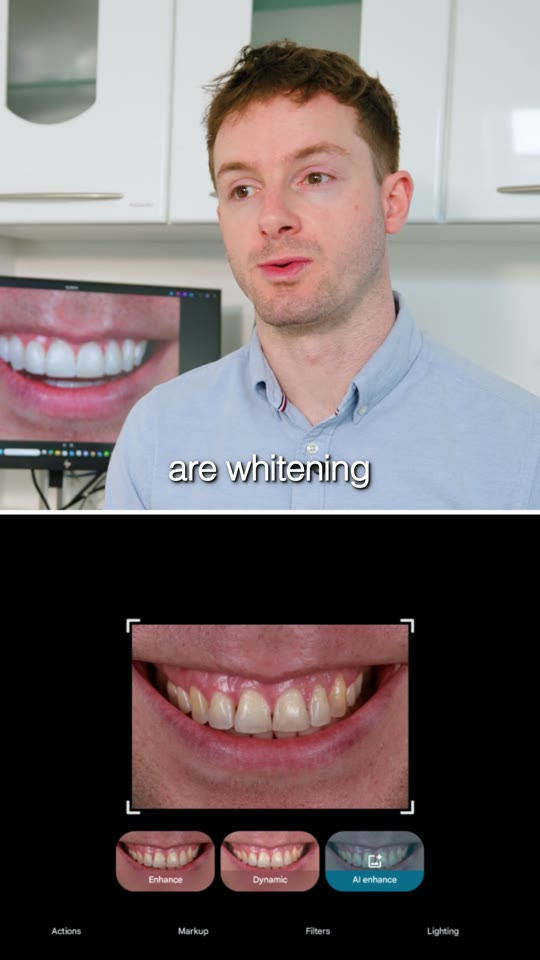
The teeth overlapped in the middle, which threw everything else off. One tooth was fanning out and sitting bigger than its opposite number. And at the back, the premolars were in crossbite, sitting inside where they should have been.
That last one produced the thing she would have described as a narrow smile without knowing why: wide dark spaces at the corners of the mouth, between the teeth and the cheeks. The clinical term is buccal corridors. They are what makes a smile read as narrow, and they are a position problem, so no amount of covering teeth over would have touched them.
46 weeks
Roughly 46 weeks of aligner treatment. The teeth at the front stopped overlapping, and the smile widened because the teeth were moved out into a better position rather than made bigger.
Then a very small amount of bonding
Composite edge bonding on the front 2 teeth. That is all.
Alex's line here is one to carry into any cosmetic consultation you ever have: composite bonding is something that can be used sparingly. It does not need to be plastered all over the teeth. Sometimes less is more.
The result is mostly her own teeth in a better position, which is why it looks like her.
The part the result actually rests on
Alex describes this as treatment you only have to do once, and then immediately attaches a condition to it. A fixed retainer behind the top teeth. A fixed retainer behind the bottom teeth. Removable retainers worn at night.
Teeth move. They were moved into this position and they will move out of it. The retainers are not aftercare, they are the second half of the treatment.
Read it in Alex's own words
So I had this lovely patient who is a singer and wanted improvement to her smile. She came in and she was embarrassed about the crowding of the teeth. The teeth were a little bit overlapped in the middle here, throwing everything off. This tooth on the right is kind of fanning out a little bit and it's a bit bigger than this one on the other side. Also at the back she's got wide kind of buccal corridors, and the reason for that is her premolars are in crossbite.
When she first came in she was actually seeking treatment with a direct to consumer aligner brand. I said come and see me and do some clear aligner treatment monitored by a dentist. It's safer moving the teeth. Someone's accountable. We know what the risks are if you're having orthodontic treatment done. It should really be done by a dentist.
So this is the result of teeth being moved. It was approximately 46 weeks in total of aligner treatment. We've got much narrower buccal corridors here. All we've done really is kind of widen the smile, moving the teeth out safely. The teeth at the front are not overlapped any more.
We did a little bit of composite edge bonding to only the front 2 teeth. Composite bonding is something that can be used sparingly. It doesn't need to be plastered all over the teeth. Sometimes less is more. I think it's a lovely result. Beautiful natural looking smile, because it's the patient's own teeth.
This is the kind of treatment that you only have to do once, as long as you have a fixed retainer on the top, little wire that goes behind the teeth, little fixed retainer on the bottom goes behind the teeth, and then removable retainers that you wear at night time.