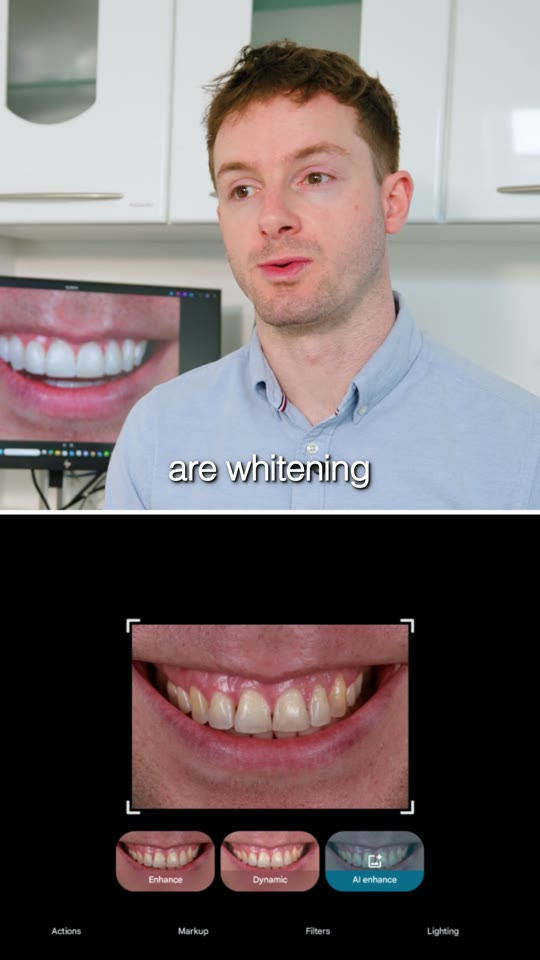
What happens when composite bonding stains or chips?
Composite bonding is not permanent. It picks up stain and it can chip, and when it does it can be taken off and replaced. Replacing it is also the chance to correct proportions the first attempt got wrong, which is often the real reason a smile looked off rather than the colour.
Request a consultationThe first thing that happened in Molly's treatment was not cosmetic. It was a filling at the back.
She had come in about her front teeth. There was a filling that needed doing and it was not going to get better on its own, so it was done first, ahead of the thing she actually wanted. In her words, he was honest with her from the beginning and prioritised the important medical stuff over the cosmetic stuff.
Alex's version is funnier and says the same thing: they did it in the right order, much to Molly's distress at the time.
Why that order is not just principle
His reasoning is practical. Do the front teeth first and you have a nice smile and a toothache, and the toothache wins. Pain from a back tooth outranks the appearance of a front one, however keen everyone is to get on with the interesting part.
What was wrong with the old bonding
Three things, and they are the three reasons bonding gets redone:
- It had stained over time.
- It had chipped.
- One tooth had ended up wider than the one next to it.
The first two are expected. Composite is not permanent, it picks up stain, and it can chip. The third is the interesting one.
How one tooth ends up wider than the other
When a gap is closed by building up one tooth and then building up the other, without working back from the midline of the face, the two teeth end up sharing the space unevenly. One carries more of it.
Most people cannot name that when they look in the mirror. They know something is off and assume it is the colour. It is usually the proportion.
So replacing bonding is not only a repair. It is the opportunity to fix a shape the first attempt got wrong, which is often the actual complaint underneath the stated one.
The limit Alex names
Here is the part that stops this being a sales pitch for bonding. When the space is large, he says, it is difficult to build the teeth up without making them look square. You can close a gap completely. Making it look right while doing so is the hard part, and sometimes the honest answer is a balance rather than a complete closure.
Molly's own summary, afterwards: nothing has chipped, nothing has stained.
Read it in Alex's own words
We met because Molly had some bonding on some front teeth to close a gap, and it stained over time. Yeah, and chipped. And one tooth was a bit wider than the other one, so we swapped it out for some fresh composite bonding.
Sorry, we had to prioritise the important stuff before we do cosmetic stuff. There was a filling at the back we needed doing, we didn't want it to get worse. Otherwise we focused on the front teeth and then we have pain from a back tooth and that's worse. So we did things in the right order, much to Molly's distress at the time, and we eventually got around to it.
I think we got a more proportional result. Yeah, definitely, 100%. Nothing's chipped, nothing's stained. Really happy.